Evolution of Search Engines and SEO: From Simple Directories to Intelligent Discovery
Introduction
Few developments have influenced digital marketing as deeply as the rise of search engines. What began as a simple method for organizing web pages has evolved into a sophisticated system that helps users find relevant information within seconds. Alongside this transformation, SEO has grown from a basic technical practice into a strategic discipline focused on visibility, relevance, and user satisfaction.
Understanding the evolution of search engines and SEO provides valuable context for marketers, business owners, and website publishers. Search behavior has changed dramatically over the years, and search engines have continuously adapted to meet higher user expectations. As a result, SEO has never remained static. Strategies that once produced strong results often became ineffective as search technology matured.
Today, search engines influence purchasing decisions, brand discovery, research processes, and customer journeys. Businesses that understand this historical progression are often better equipped to make informed marketing decisions and adapt to future changes.
The Early Days of Search Engines
In the early years of the internet, finding information online was far from easy. The web was growing rapidly, but users had limited ways to navigate it. Early search engines and web directories attempted to solve this problem by cataloging websites and organizing them into categories.
Platforms such as Yahoo Directory relied heavily on human review and manual classification. Website owners submitted their pages, and editors decided where those pages belonged. While this approach worked during the internet’s early growth, it quickly became difficult to maintain as the number of websites expanded.
Search engines later introduced automated systems that could crawl and index web pages. This innovation marked a major shift in how information was discovered online. Instead of relying entirely on human organization, search engines began analyzing website content and presenting results based on relevance.
The Birth of SEO
As search engines became more popular, website owners realized that higher visibility could attract more visitors. This realization gave rise to SEO.
In its earliest form, SEO was relatively straightforward. Search engines depended heavily on page content and keyword usage to determine relevance. Many website owners focused primarily on inserting keywords throughout their pages in an effort to rank higher.
Because search algorithms were less sophisticated, these tactics often produced results. However, they also created problems. Some websites prioritized rankings over user experience, leading to poor quality content that satisfied search engines more than actual visitors.
This period established an important lesson that continues to influence SEO today. Search visibility may attract visitors, but sustainable success depends on delivering genuine value.
Why Search Engines Continued to Evolve
As internet usage increased, search engines faced growing pressure to improve result quality. Users expected accurate answers, trustworthy sources, and relevant content. Poor search experiences could reduce confidence in the platform itself.
To address these challenges, search engines began refining their ranking systems. They introduced new methods for evaluating authority, relevance, and quality. Instead of relying solely on keyword frequency, algorithms started examining broader signals that reflected the usefulness of a webpage.
This shift fundamentally changed the relationship between search engines and SEO. Ranking success gradually became less about manipulating signals and more about creating meaningful experiences for users.
Strategic Thinking in Modern SEO
The history of SEO reveals a consistent pattern. Every major change in search technology has pushed website owners toward better practices. As search engines improved, successful SEO strategies became increasingly aligned with user needs.
Rather than viewing SEO as a collection of isolated tactics, experienced marketers began treating it as a long term strategic process. Visibility, content quality, site structure, and user experience became interconnected elements of sustainable growth.
The evolution of search engines and SEO demonstrates that lasting results rarely come from shortcuts. They emerge from understanding how people search, what they expect to find, and how websites can serve those expectations effectively.
Search Engines and Business Goals: A Growing Connection
As search engines became more sophisticated, businesses began to recognize that SEO was not simply a traffic generation tactic. It became a strategic component of broader marketing and business objectives. The most successful organizations learned that search visibility only creates value when it supports meaningful outcomes.
Many companies initially focused on rankings alone. While ranking improvements often increased website traffic, traffic by itself did not guarantee business growth. A website could attract thousands of visitors and still struggle to generate leads, sales, or customer engagement.
This realization encouraged businesses to connect SEO efforts with measurable organizational goals. Search performance became part of a larger strategy that supported revenue growth, customer acquisition, brand awareness, and customer retention.
Aligning SEO With Business Objectives
The evolution of search engines and SEO has consistently rewarded organizations that align marketing activities with business priorities.
For example, a local service company may prioritize generating qualified inquiries from nearby customers. In this case, local search visibility becomes more important than attracting visitors from unrelated regions. On the other hand, an ecommerce retailer may focus on increasing product sales through category pages and product searches.
When SEO efforts support clearly defined business outcomes, decision making becomes more focused. Content creation, website improvements, and optimization activities can then contribute directly to organizational growth rather than simply improving vanity metrics.
Businesses that fail to establish this connection often invest significant resources without understanding whether their efforts are producing meaningful results.
Defining Clear and Measurable Marketing Objectives
Search engines have evolved to understand user intent more accurately than ever before. As a result, marketers must also become more precise in defining their objectives.
Clear goals create direction. They help determine what success looks like and provide benchmarks for evaluating performance.
A business might establish objectives such as increasing qualified organic traffic, generating more consultation requests, improving product page conversions, or expanding visibility for specific service categories. Each objective creates a framework for making strategic decisions.
Measurable objectives also encourage accountability. Instead of asking whether SEO is working, marketers can evaluate specific indicators connected to desired outcomes.
The evolution of search engines and SEO has shown that organizations with clear goals often adapt more effectively because they understand what they are trying to achieve and why it matters.
Understanding the Target Audience
One of the most important shifts in search marketing has been the growing emphasis on audience understanding.
Early SEO often focused heavily on keywords. While keywords remain important, modern search engines attempt to understand the intent behind those searches. Consequently, marketers must understand their audiences at a deeper level.
Successful SEO begins with questions such as:
- What problems are customers trying to solve?
- What information are they seeking?
- What concerns influence their decisions?
- How do they evaluate available options?
Answering these questions helps businesses create content that matches genuine user needs rather than simply targeting search terms.
For instance, a homeowner searching for “roof repair cost” may be in a different stage of decision making than someone searching for “emergency roof repair near me.” Although both searches relate to roofing services, the intent behind each search differs significantly.
Understanding these distinctions enables businesses to create more relevant content and improve the overall user experience.
The Role of the Customer Journey
The customer journey has become increasingly important as search engines have improved their ability to interpret intent.
Most purchasing decisions do not happen instantly. People typically move through several stages before taking action. They identify a need, research solutions, compare options, evaluate providers, and eventually make a decision.
Search behavior often reflects these stages.
A person interested in financial planning may begin by searching for educational information. Later, that same individual may compare services, read reviews, and eventually search for a local advisor.
Businesses that understand this journey can create content that supports users at each stage. Educational articles help build awareness. Detailed service pages support evaluation. Case studies and testimonials provide reassurance during decision making.
The evolution of search engines and SEO has encouraged marketers to think beyond individual keywords and consider the broader context of customer needs.
Practical Examples of Strategic Search Alignment
Consider a software company seeking business clients. Instead of targeting only highly competitive product keywords, the company might create educational content addressing common industry challenges. This approach attracts prospects earlier in their research process and establishes credibility before purchase decisions occur.
Similarly, a healthcare provider may create content that answers frequently asked patient questions. These resources improve visibility while also building trust among potential patients who are searching for reliable information.
In both examples, SEO serves a larger purpose. Search visibility supports business goals because content addresses real customer needs at the appropriate stage of the journey.
The strongest search strategies emerge when organizations understand their objectives, know their audience, and create experiences that align with both.
Choosing the Right Channels in an Evolving Search Landscape
The evolution of search engines and SEO has changed how businesses approach digital channels. In the early days, simply appearing in search results could generate substantial visibility. Today, audiences interact with brands across multiple touchpoints before making decisions.
This shift makes channel selection an important strategic decision. Businesses often have limited resources, which means they cannot invest equally in every platform or marketing activity. Success depends on identifying the channels that best align with audience behavior and business goals.
Search remains one of the most valuable channels because it captures existing demand. People actively searching for information, products, or services are often closer to taking action than audiences reached through interruption based marketing methods.
However, search rarely operates in isolation. Users may discover a brand through social media, return through organic search, read reviews, and eventually convert after several interactions. Understanding how these channels work together helps businesses allocate resources more effectively.
Rather than chasing every new opportunity, successful marketers focus on the channels that consistently support customer acquisition and long term growth.
Content Strategy as the Foundation of SEO
Throughout the evolution of search engines and SEO, one element has remained consistently important: content.
Search engines exist to connect users with useful information. As algorithms have become more advanced, they have improved their ability to evaluate whether content genuinely satisfies user needs.
A strong content strategy begins with understanding audience questions, challenges, and goals. Businesses that create content solely to target keywords often struggle to build lasting visibility. In contrast, organizations that address real customer concerns tend to create resources that remain valuable over time.
Effective content can take many forms. Educational articles, detailed service pages, buying guides, case studies, and frequently asked questions all serve different purposes within the customer journey.
The key is relevance. Every piece of content should help users accomplish something meaningful. When content provides clear answers and useful insights, it naturally supports both user satisfaction and search performance.
As search engines continue to improve, content quality remains one of the strongest competitive advantages available to businesses.
The Growing Importance of User Experience
The relationship between SEO and user experience has become increasingly strong over the years.
Early search optimization often focused primarily on technical factors and keyword placement. Modern search engines evaluate a much broader range of signals that reflect overall user satisfaction.
Visitors expect websites to load quickly, display properly across devices, and provide information without unnecessary obstacles. When users encounter frustration, they often leave and continue their search elsewhere.
This behavior creates challenges for businesses. A page may achieve strong rankings, but poor user experience can still reduce conversions and customer engagement.
User experience extends beyond design. It includes navigation, readability, content organization, accessibility, and ease of interaction. Every element influences how visitors perceive a brand and whether they remain engaged.
The evolution of search engines and SEO demonstrates a clear trend toward rewarding websites that prioritize the needs of real users rather than focusing exclusively on ranking factors.
Maintaining Brand Consistency Across Search Experiences
As businesses expand their digital presence, maintaining consistent messaging becomes increasingly important.
Potential customers often encounter a brand through multiple search results, content pieces, and website pages before making a decision. Inconsistent messaging can create confusion and weaken trust.
A clear brand voice helps establish credibility. Whether users read a blog article, visit a service page, or explore product information, they should encounter a consistent experience that reflects the organization’s values and expertise.
Consistency also strengthens recognition. Repeated exposure to aligned messaging helps audiences understand what a business stands for and what differentiates it from competitors.
The evolution of search engines and SEO has increased the importance of trust signals. Search engines aim to connect users with reliable information, while users seek confidence in the brands they choose. Consistent communication supports both objectives.
Conversion Focused Thinking
Generating traffic is only one part of a successful search strategy. Businesses ultimately need visitors to take meaningful actions.
Conversion focused thinking encourages marketers to consider what happens after someone arrives on a website. Every page should have a clear purpose and guide users toward the next logical step.
For a consulting firm, that step may be scheduling a consultation. For an ecommerce store, it may be completing a purchase. For a software company, it could involve requesting a demonstration or starting a trial.
Effective conversion strategies remove unnecessary friction. Clear messaging, strong value propositions, intuitive navigation, and persuasive content help users move forward with confidence.
Importantly, conversion optimization does not mean applying pressure. Instead, it means creating an experience that helps visitors make informed decisions more easily.
The evolution of search engines and SEO has shown that sustainable growth comes from balancing visibility with user value. Traffic alone is not the goal. The true objective is connecting the right audience with the right solution at the right time.
Measuring Success in Modern SEO
The evolution of search engines and SEO has made measurement more important than ever. As search algorithms have become increasingly sophisticated, businesses can no longer rely on rankings alone to evaluate performance.
A high ranking position may generate visibility, but visibility does not automatically translate into business results. Organizations must track indicators that reflect both marketing effectiveness and business impact.
Key performance indicators often include organic traffic growth, engagement metrics, lead generation, conversion rates, revenue contribution, and customer acquisition outcomes. These measurements provide a clearer picture of whether SEO efforts support broader organizational goals.
Measurement also helps businesses identify opportunities for improvement. When marketers understand which content attracts qualified visitors and which pages contribute to conversions, they can make better strategic decisions.
The evolution of search engines and SEO has reinforced an important principle: meaningful metrics matter more than surface level numbers.
Continuous Improvement and Testing
Search behavior changes constantly. Consumer expectations evolve, industries shift, and search engines continue refining their algorithms.
Because of this reality, successful SEO is not a one time project. It is an ongoing process of learning, adapting, and improving.
Organizations that consistently review performance data often gain valuable insights into audience behavior. They discover which topics resonate most strongly, which content formats perform best, and which pages create obstacles within the customer journey.
Testing plays a central role in this process. Small improvements to page structure, content clarity, user experience, or calls to action can produce meaningful gains over time.
Continuous improvement allows businesses to remain competitive even as market conditions change. Rather than reacting only when performance declines, they actively refine their strategies based on evidence and user feedback.
The evolution of search engines and SEO demonstrates that long term success often belongs to organizations that embrace ongoing optimization rather than pursuing short term wins.
Scaling SEO Responsibly
As businesses grow, their SEO strategies often expand as well. More products, services, locations, and content opportunities create additional possibilities for search visibility.
However, growth introduces complexity.
Many organizations make the mistake of prioritizing volume over quality. They publish excessive content, create redundant pages, or pursue expansion without a clear strategic purpose. While these efforts may increase website size, they do not necessarily improve performance.
Responsible scaling focuses on maintaining quality while increasing reach. Every new page, article, or resource should contribute value to users and support business objectives.
Strong processes become increasingly important during growth phases. Consistent content standards, regular performance reviews, and clear strategic priorities help organizations expand without sacrificing quality.
The evolution of search engines and SEO has consistently rewarded websites that provide useful, relevant experiences. This principle remains true regardless of company size.
Common SEO Mistakes to Avoid
Throughout the history of search marketing, certain mistakes have appeared repeatedly.
One common error is focusing exclusively on rankings. While rankings remain important, they represent only one part of a broader strategy. Businesses must also consider user experience, engagement, and conversion performance.
Another frequent mistake involves creating content without understanding audience intent. Content that fails to address real user needs rarely delivers sustainable results, regardless of how well it is optimized.
Many organizations also underestimate the importance of website usability. Slow loading pages, confusing navigation, and poor mobile experiences can undermine even the strongest content strategy.
Inconsistent messaging presents another challenge. When different pages communicate conflicting information, users may lose confidence in the brand.
Finally, some businesses chase short term tactics instead of building long term value. The evolution of search engines and SEO shows that sustainable growth typically comes from serving users effectively rather than attempting to exploit temporary opportunities.
The Famous Google and Yahoo Story
One of the most discussed stories in internet business history involves Google and Yahoo during the early growth of the search industry.
In the late 1990s, Yahoo was one of the most recognizable names on the internet. Millions of users relied on Yahoo’s directory and search services to navigate the rapidly expanding web. At the same time, Google was a young company founded by Larry Page and Sergey Brin, focused on improving search quality through its PageRank algorithm.
According to widely reported accounts, Google’s founders explored the possibility of selling the company in its early years. Various figures have been mentioned over time, including discussions around a sale price of approximately $1 billion. Yahoo reportedly showed interest but did not proceed with an acquisition under the terms being sought.
At the time, Yahoo’s leadership viewed itself primarily as a media and portal company rather than a search focused business. Search was considered an important feature, but not necessarily the company’s core strategic asset.
Google continued operating independently and focused relentlessly on improving search relevance and user experience. Over the following years, Google’s market share grew dramatically, and it became the dominant search engine globally.
Looking back, many analysts consider Yahoo’s decision one of the most significant missed opportunities in technology history. While the exact details and valuations vary depending on the source and period discussed, the broader lesson remains clear: recognizing transformative innovation is often easier in hindsight than in the moment.
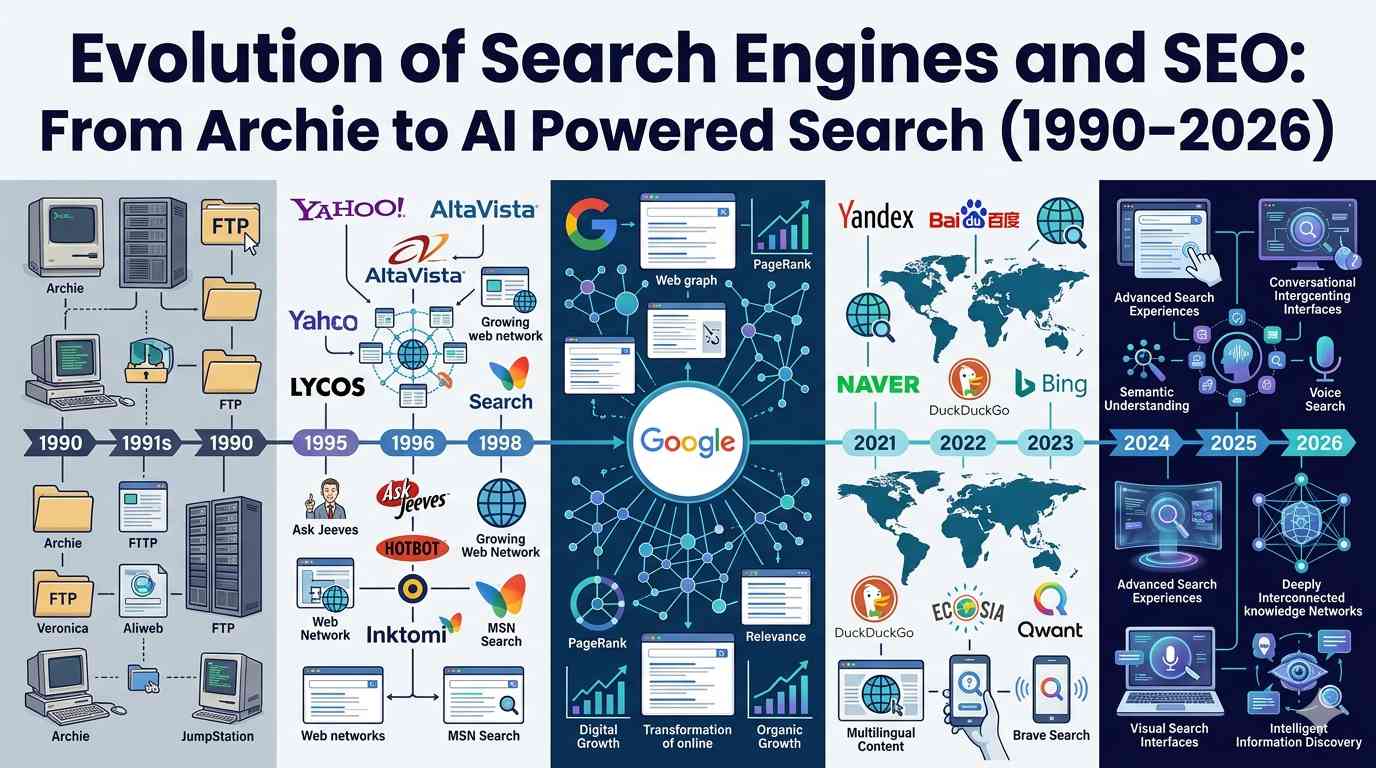
Major Search Engines That Shaped the Evolution of Search Engines and SEO (1990–2026)
Ask Jeeves (1996)
Ask Jeeves introduced a unique approach to online search by encouraging users to type questions in natural language. Instead of relying solely on keywords, users could ask complete questions such as “What is the capital of France?” This made search feel more intuitive, especially for people who were new to the internet.
The platform featured a butler character named Jeeves, which helped create a distinctive brand identity. During the late 1990s and early 2000s, Ask Jeeves became one of the most recognized search brands on the web. Over time, the company improved its search technology through acquisitions, including Teoma, which enhanced the relevance of its results.
As Google continued to dominate the market, Ask gradually shifted away from competing directly as a major search engine. Nevertheless, it remains an important part of search history because it pioneered conversational searching long before modern search experiences became common.
Founded: 1996
Rebranded: Ask.com (2006)
Current Status: Active
HotBot (1996)
HotBot quickly gained popularity during the late 1990s because of its fast performance and extensive search index. Powered initially by Inktomi technology, HotBot offered advanced search options that appealed to both casual users and experienced web researchers.
One of HotBot’s strengths was its ability to provide detailed filtering options. Users could refine searches using dates, domains, and various advanced parameters. At a time when search technology was still developing, these features helped differentiate the platform from competitors.
Despite its strong early growth, HotBot struggled as larger companies consolidated the search industry. The rise of Google, Yahoo, and MSN reduced its visibility significantly. Although the brand survived through various ownership changes, its influence gradually faded.
Even so, HotBot represents an important chapter in the evolution of search engines and SEO because it helped establish expectations for advanced search functionality.
Founded: 1996
Ownership Changes: Multiple acquisitions and mergers
Current Status: Limited relevance
Northern Light (1997)
Northern Light stood apart from many competitors because it combined traditional web search with premium research content. The platform became especially popular among business professionals, researchers, and academic users who needed access to specialized information.
Unlike many consumer focused search engines, Northern Light emphasized information quality and organization. Users could search both public web content and proprietary databases through a single interface. This approach provided a deeper level of research capability than many competing platforms.
As consumer search became increasingly dominated by Google, Northern Light shifted its focus toward enterprise search solutions. While it never achieved Google’s scale, it demonstrated that specialized search services could provide significant value to professional audiences.
The company remains a noteworthy example of how search technology evolved beyond simple webpage discovery.
Founded: 1997
Current Status: Enterprise search provider
Yandex (1997)
Yandex emerged as Russia’s leading search engine and remains one of the most successful regional search platforms in the world. Founded by Arkady Volozh and Ilya Segalovich, Yandex was specifically designed to understand the complexities of the Russian language.
Because Russian grammar is highly complex, many international search engines struggled to deliver accurate results. Yandex addressed this challenge through sophisticated linguistic analysis and local market expertise.
Over time, the company expanded beyond search into maps, email, ecommerce, transportation services, cloud solutions, and artificial intelligence technologies. For many users in Russia and neighboring countries, Yandex became an essential part of daily digital life.
Its continued success demonstrates that local market knowledge can remain a powerful competitive advantage, even in a globalized internet ecosystem.
Founded: 1997
Current Status: Active
Primary Markets: Russia and neighboring regions
Google Search (1998)
Google fundamentally changed the search industry. Founded by Larry Page and Sergey Brin, the company introduced PageRank, an algorithm that evaluated webpage authority based on links from other websites.
This innovation improved search quality dramatically. Instead of relying primarily on keyword matching, Google considered the broader structure of the web when determining relevance. As a result, users often received more useful and trustworthy search results.
The company’s clean homepage also distinguished it from competitors that filled their interfaces with news, advertisements, and portal features. Users appreciated the simplicity and speed.
Over the following decades, Google expanded its ranking systems to include hundreds of signals related to content quality, user experience, authority, and intent. Its influence shaped nearly every aspect of modern SEO.
Today, Google remains the dominant search engine in most global markets and continues to drive innovation in information retrieval.
Founded: 1998
Current Status: Active
Market Position: Global leader in search
MSN Search (1998)
Microsoft entered the search market with MSN Search as part of its broader MSN portal strategy. Initially, the platform relied on third party providers for search results before developing more independent capabilities.
MSN Search represented Microsoft’s first major effort to compete in online search. While it never achieved the popularity of Yahoo or Google during its early years, it provided valuable experience that would later contribute to Bing’s development.
The platform underwent several changes as Microsoft refined its search strategy. Eventually, MSN Search evolved into Windows Live Search and later Bing.
Although the MSN Search brand no longer exists, it played a crucial role in Microsoft’s long term commitment to the search industry.
Founded: 1998
Rebranded: Windows Live Search (2006)
Current Status: Retired
Naver (1999)
Naver is South Korea’s leading search engine and one of Asia’s most successful technology platforms. Founded in 1999 by former Samsung employees, it became the first Korean search engine to develop its own search and indexing technology.
Unlike many Western search engines, Naver built a complete content ecosystem. Search results often include blogs, news, shopping results, videos, maps, and community content. As a result, users can find information without leaving the platform.
A major milestone came in 2002 with the launch of Knowledge iN, a question and answer service. Users could ask questions and receive responses from other community members. Consequently, Naver created a large database of localized content that improved the search experience.
Naver’s deep understanding of Korean language and culture helped it maintain strong market leadership. While Google dominates many countries, Naver remains the preferred search platform for many users in South Korea.
For SEO professionals, Naver requires a different approach. Businesses often focus on Naver Blog, Knowledge iN, local listings, and news content rather than relying only on traditional backlink strategies.
Today, Naver offers services in ecommerce, cloud computing, finance, mobile applications, webtoons, and artificial intelligence. Its success shows how local market expertise can create a lasting competitive advantage in the evolution of search engines and SEO.
Founded: 1999
Headquarters: Seongnam, South Korea
Notable Innovation: Knowledge iN (2002)
Current Status: Active
Primary Market: South Korea
Parent Company: NAVER Corporation
Market Significance: Dominant search engine in South Korea and one of Asia’s leading technology companies.
AllTheWeb (1999)
AllTheWeb earned a reputation for technical excellence and a large search index. Developed by the Norwegian company Fast Search & Transfer, it introduced innovations related to crawling speed and search freshness.
Many industry observers viewed AllTheWeb as one of the strongest competitors to Google during the early 2000s. The platform frequently updated its index and offered advanced search capabilities that appealed to power users.
Despite its technological strengths, market consolidation limited its growth opportunities. Overture acquired the company in 2003, and Yahoo later acquired Overture during the same year.
The AllTheWeb brand eventually disappeared, but its technology contributed to the ongoing development of search infrastructure.
Founded: 1999
Acquired By Overture: 2003
Acquired By Yahoo: 2003
Status: Closed
Baidu (2000)
Baidu became China’s leading search engine by focusing on the specific needs of Chinese internet users. Founded by Robin Li and Eric Xu, the company developed search technology optimized for the Chinese language and local online behavior.
As internet adoption accelerated across China, Baidu expanded rapidly. The company also diversified into maps, cloud services, artificial intelligence, video platforms, and autonomous technologies.
Baidu’s growth highlights the importance of local market expertise in search. Understanding language, culture, regulations, and user preferences helped the company establish a dominant position within one of the world’s largest digital markets.
Today, Baidu remains one of the most influential search companies globally.
Founded: 2000
Current Status: Active
Primary Market: China
Teoma (2001)
Teoma introduced an innovative approach to search ranking based on topical communities and subject authority. Instead of evaluating links in a general way, Teoma attempted to identify expert communities related to specific topics.
This approach helped improve relevance within specialized subject areas. The technology attracted significant attention because it offered an alternative perspective on how search quality could be evaluated.
Ask Jeeves recognized the value of Teoma’s technology and acquired the company. Teoma subsequently became the foundation for Ask’s search infrastructure.
Although the brand itself eventually disappeared, its concepts influenced broader discussions about authority and relevance in search.
Founded: 2001
Acquired By Ask Jeeves: 2001
Status: Integrated into Ask technology
Windows Live Search (2006)
Windows Live Search represented Microsoft’s effort to modernize and strengthen its search capabilities. The rebranding reflected the company’s broader Windows Live initiative, which aimed to unify various online services.
The platform introduced improvements in indexing, relevance, and user interface design. However, Microsoft soon recognized the need for a stronger and more distinct search identity.
As a result, Windows Live Search served primarily as a transitional stage between MSN Search and Bing. Although its lifespan was relatively short, it helped establish the technical foundation for Microsoft’s future search ambitions.
Launched: 2006
Replaced By Bing: 2009
Status: Retired
Cuil (2008)
Cuil was founded by former Google employees who aimed to challenge Google’s dominance. The company claimed to have indexed more webpages than any competitor at the time.
The search engine featured a distinctive visual design and attempted to organize results differently from traditional search platforms. Industry observers initially showed considerable interest because of the team’s background and ambitious goals.
However, users often reported inconsistent result quality and relevance issues. Despite attracting significant media attention, Cuil struggled to gain meaningful market share.
The company eventually ceased operations, demonstrating the difficulty of competing against established search leaders.
Founded: 2008
Closed: September 2010
DuckDuckGo (2008)
DuckDuckGo built its reputation around user privacy. Unlike many competitors, the company emphasized minimal tracking and avoided creating detailed personal profiles for advertising purposes.
This positioning resonated with users who were increasingly concerned about data collection practices. Over time, DuckDuckGo expanded its features while maintaining a strong focus on privacy.
The search engine also introduced useful tools such as instant answers and simplified search experiences. Although its market share remains much smaller than Google’s, it has become one of the most recognized alternative search engines in the world.
Its success demonstrates that privacy can be a meaningful differentiator within the search industry.
Founded: 2008
Current Status: Active
Bing (2009)
Microsoft launched Bing in 2009 as a major reimagining of its search strategy. The company aimed to compete more effectively with Google by emphasizing decision making support rather than simple information retrieval.
Bing introduced visual search enhancements, travel tools, shopping features, and deeper integration with Microsoft’s ecosystem. Over time, the platform improved significantly in relevance and search quality.
Partnerships also strengthened Bing’s position. For many years, Bing powered portions of Yahoo Search and other services. Additionally, its integration into Windows helped maintain broad user exposure.
Today, Bing remains the second largest search engine in many markets and continues to play an important role in the search ecosystem.
Founded: 2009
Current Status: Active
Ecosia (2009)
Ecosia differentiated itself through an environmental mission. The company uses advertising revenue to fund tree planting projects around the world.
Users perform searches much like they would on any traditional search engine. However, a portion of the resulting revenue supports reforestation efforts. This model attracted environmentally conscious users who wanted their online activities to contribute to sustainability initiatives.
Over the years, Ecosia has funded the planting of hundreds of millions of trees across numerous countries. Its growth illustrates how purpose driven business models can attract loyal audiences.
Founded: 2009
Current Status: Active
Qwant (2013)
Qwant is a European search engine that emphasizes privacy and data protection. Developed in France, the platform emerged partly in response to growing concerns about user tracking and market concentration within the search industry.
The company promotes a search experience that respects user privacy while still delivering relevant results. Qwant also positions itself as a European alternative to dominant international search providers.
Although its market share remains relatively small, it has gained support among users seeking greater control over their digital privacy.
Founded: 2013
Current Status: Active
Brave Search (2021)
Brave Search was developed by Brave Software, the company behind the Brave browser. Unlike many alternative search engines that rely heavily on larger providers, Brave invested in building its own search index.
This independence allows the company greater control over search results and ranking methodologies. Privacy remains a central part of its value proposition, aligning closely with the philosophy of the Brave browser ecosystem.
The launch of Brave Search reflected growing interest in search diversity and reduced dependence on a small number of dominant providers.
Founded: 2021
Current Status: Active
Neeva (2021)
Neeva attempted to create a subscription based search engine that operated without advertising. Founded by former Google executives, the company sought to provide a cleaner and less commercially driven search experience.
The concept attracted attention because it challenged the advertising supported model that dominates the search industry. Users paid a subscription fee in exchange for ad free results and enhanced privacy.
Despite innovative ideas, Neeva struggled to achieve large scale adoption. The company eventually discontinued its consumer search service and was acquired by Snowflake.
Its story highlights the challenges of introducing alternative business models within a highly competitive market.
Founded: 2021
Acquired By Snowflake: 2023
Consumer Search Closed: June 2023
AI Powered Search Experiences (2024–2026)
The period between 2024 and 2026 introduced a new phase in the evolution of search engines and SEO. Search platforms increasingly incorporated conversational interfaces, contextual understanding, and advanced language processing capabilities.
Instead of presenting only lists of links, modern search experiences began providing synthesized answers, summaries, and interactive responses. This shift changed how users interact with information and how businesses approach visibility strategies.
While traditional search results remain important, conversational discovery is becoming an increasingly significant part of the search ecosystem. As a result, SEO continues to evolve alongside changing user expectations and search technologies.
Status: Rapidly evolving category
Period: 2024–2026
Search Engines Still Active in 2026
The major active search engines as of 2026 include:
- Bing
- Yahoo Search
- Yandex
- Baidu
- DuckDuckGo
- Brave Search
- Ecosia
- Qwant
- Ask.com
Together, these platforms represent more than three decades of innovation. Their history illustrates how the evolution of search engines and SEO has continuously moved toward better relevance, stronger user experiences, greater personalization, enhanced privacy options, and more effective information discovery.
Conclusion
The evolution of search engines and SEO reflects the broader development of the internet itself. What began as a simple effort to organize online information has become a highly sophisticated ecosystem designed to deliver relevant, trustworthy, and useful results.
Over the years, search engines have moved far beyond basic keyword matching. They now evaluate content quality, user intent, authority, relevance, and overall experience. This progression has steadily encouraged businesses to adopt more customer focused strategies.
The history of SEO reveals a consistent lesson. Lasting success comes from understanding people. Businesses that align their goals with audience needs, create valuable content, deliver strong user experiences, and continuously improve their approach are better positioned to achieve sustainable growth.
As search technology continues to evolve, the core principles remain remarkably stable. Relevance, trust, quality, and user satisfaction continue to guide effective SEO strategies. Organizations that build around these foundations can adapt to change with confidence while maintaining meaningful visibility in an increasingly competitive digital landscape.