Google SEO Updates 2026–2027: What Website Owners and Marketers Must Do to Rank Higher
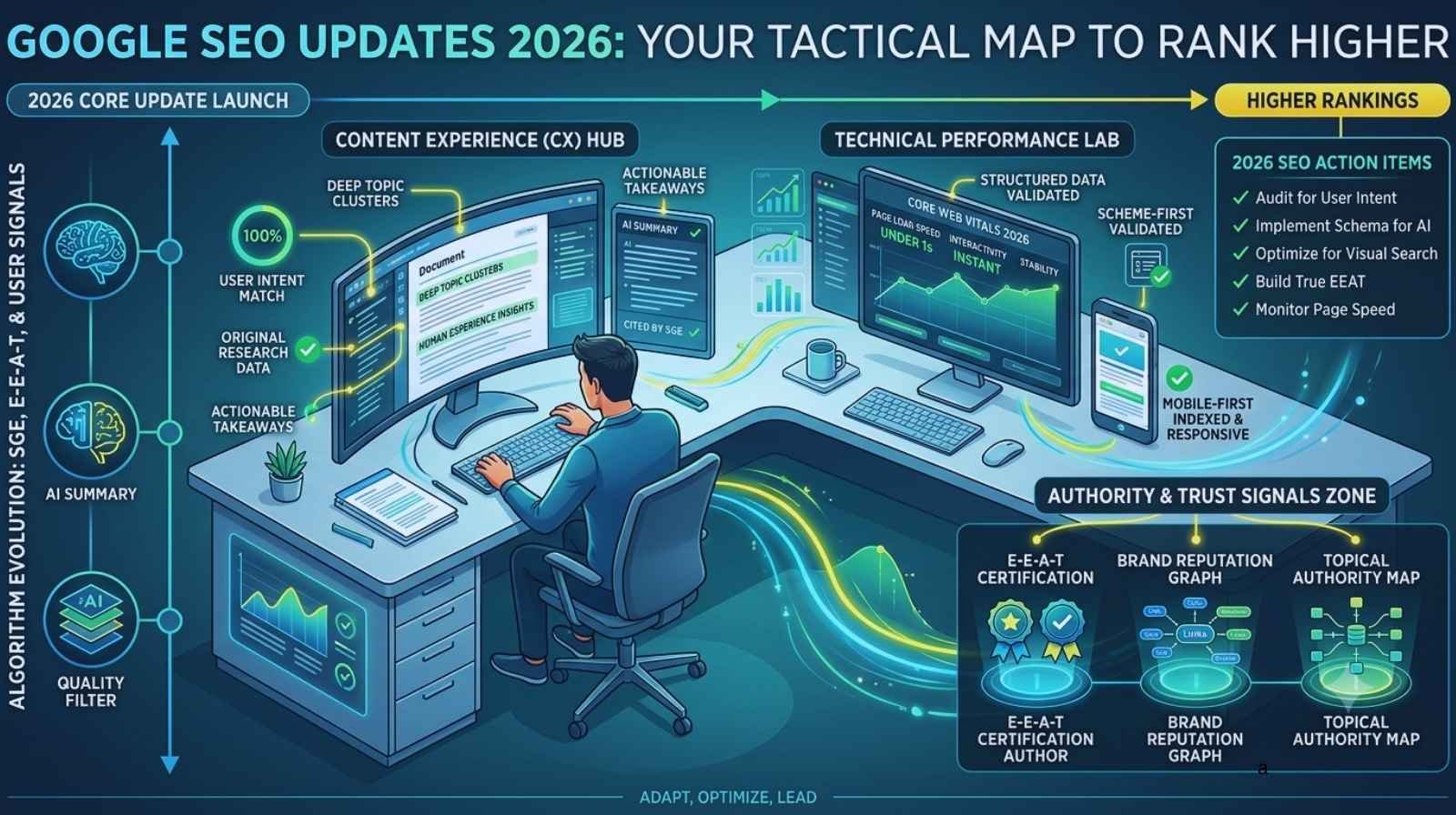
Google SEO updates in 2026 and 2027 continue to redefine how websites appear in search results. For website owners and marketers, these updates are not something to fear but something to master. Google’s fundamental goal remains unchanged: it wants to show users the most helpful, relevant, and trustworthy content. Every update moves closer to that goal.
However, how search engine results pages (SERPs) operate has fundamentally transformed. Ranking higher is no longer about shortcuts, basic keyword density, or static link placements. It now depends on Multi-Engine Optimization (SEO, GEO, and AEO), deep topical authority, zero-click answer clarity, and genuine human experience. Websites that adapt to these expectations see steady, scalable growth. Those that ignore them often struggle to maintain organic visibility.
This guide breaks down what Google SEO updates in 2026 and 2027 focus on across every core criteria, providing actionable steps for website owners and marketers to stay competitive.
1. Navigating the Multi-Engine Landscape: SEO, GEO, and AEO
Google updates today are more refined than ever. Rather than sudden, isolated algorithm shifts, updates quietly improve how AI engines evaluate, extract, and synthesize web content.
To rank higher, marketers must optimize across three interconnected pillars:
- Traditional SEO (Search Engine Optimization): Ensures your site is crawled, indexed, and evaluated for base ranking criteria.
- GEO (Generative Engine Optimization): Ensures your content is authoritative, nuanced, and detailed enough to be cited inside Google’s AI Overviews, Gemini, Perplexity, and conversational AI features.
- AEO (Answer Engine Optimization): Formats content so AI systems can easily extract direct, concise answers for instant user queries.
Rather than chasing individual updates, success lies in aligning with Google’s long-term principles: delivering structured, extractable, and high-value knowledge that both search engines and AI models can trust.
2. Advanced Search Intent & Semantic Topic Mapping
Search intent has evolved from matching basic keywords to satisfying multi-layered, conversational user journeys. Google now evaluates topical completeness and semantic entities over static keyword phrases.
- Understanding Query Fan-Out: When a user enters a prompt, modern search engines automatically break it down into multiple sub-queries behind the scenes. To rank, your content must address both the primary query and the logical follow-up questions a user will naturally have next.
- Building Topic Clusters & Entity Graphs: Google looks at how concepts connect. Creating dedicated hub pages supported by detailed, interlinked sub-topic articles signals high topical authority within your niche.
- Matching Multi-Tiered Intent: Informational queries need clear, direct summaries followed by deep breakdowns; commercial queries require structured comparison tables, key metrics, and actionable decision frameworks. When intent and content align, engagement improves and bounce rates drop.
3. Human Experience & Trust Signals (E-E-A-T) as the Primary Ranking Filter
With AI-generated content flooding the web, Google places a stronger emphasis than ever on E-E-A-T (Experience, Expertise, Authoritativeness, and Trustworthiness). Generic summaries and rehashed information struggle to compete.
- Proof of First-Hand Experience: Google actively rewards content that offers proprietary data, original research, hands-on testing, original visuals, or real-world case studies that cannot be duplicated by an automated model.
- Author & Brand Entity Clarity: Articles must be tied to clear author entities with verifiable credentials, published histories, and active digital footprints (such as LinkedIn or industry publications).
- Off-Page Brand Authority: Unlinked brand mentions, press coverage, podcast appearances, and natural discussions across third-party platforms (like Reddit, YouTube, and industry forums) act as critical trust signals for AI search models.
4. Technical Architecture for AI & Machine Readability
While high-value content leads, technical SEO provides the foundational structure that allows both traditional crawlers and AI retrieval models (RAG) to understand and parse your site.
- Extractable Content Architecture: Lead key sections with concise, fact-dense introductory summaries (30–50 words). Use clear, question-based headings ($H2$/$H3$), structured markdown-style bullet points, and comparison tables so AI models can easily summarize your insights.
- Granular Schema Markup: Implement advanced Schema (such as Article, FAQ, HowTo, Product, and Organization) to provide explicit structural context to search algorithms.
- Instant Page Performance: Core Web Vitals remain essential. Sub-second load speeds on mobile devices prevent user drop-off when searchers click through from AI citations.
- Site Hygiene: Promptly fixing broken links, eliminating duplicate content, and maintaining clean indexing schedules ensures search bots allocate crawl budget to your highest-value pages.
5. User Experience & Conversational Engagement
Modern search interfaces are conversational and interactive. Providing a seamless, fast, and visually engaging experience keeps users returning directly to your brand.
Building Brand Loyalty: As users gain the ability to select “Preferred Sources” inside search environments, site owners should focus on turning search visitors into direct subscribers via newsletters, bookmarks, and direct brand searches.
Zero-Click Value & Citation Traffic: Even when AI summaries provide instant answers directly on the search page, earning high-visibility brand citations within those overviews builds strong authority and drives high-intent referral traffic.
Visual Contextualization: Enhance written text with custom diagrams, screenshots, infographics, and short embedded video clips to increase page dwell time and capture visual search visibility.
Strategic Checklist for Website Owners & Marketers (2026–2027)
| Criteria | Core Focus | Action Items |
| Search Framework | SEO + GEO + AEO | Add extractable Q&A sections and optimize content structure for AI citations. |
| Search Intent | Query Fan-Out & Entities | Build comprehensive topic clusters that answer immediate and follow-up user questions. |
| E-E-A-T & Trust | Real-World Experience | Incorporate original data, real case studies, direct quotes, and verified author entities. |
| Technical SEO | Machine Readability | Use clean HTML hierarchies, detailed Schema markup, and maintain sub-1-second mobile page loads. |
| User Experience | Fast Extraction & Recall | Place key takeaways at the top of pages, leverage rich media, and foster direct audience retention. |
Understanding the Direction of Google SEO Updates in 2026
Google updates today are more refined than ever. Instead of sudden dramatic changes most updates quietly improve how search results are evaluated. The emphasis is on usefulness accuracy and user satisfaction.
Search engines now analyze how people interact with content. They look at relevance clarity and engagement. Pages that genuinely answer questions tend to perform better over time. This shift means that SEO is closely tied to content quality and user experience.
Rather than chasing updates it is more effective to align with Google long term principles. These principles have remained consistent even as algorithms evolve.
Content Quality Matters More Than Ever
Content quality sits at the center of Google SEO updates in 2026. Thin pages generic writing and repeated information struggle to rank. Google favors content that shows depth understanding and clear intent.
Website owners should focus on writing for people first. Content should answer real questions and provide useful explanations. Clear structure helps readers navigate the page and find what they need quickly.
Updating old content also plays an important role. Pages that stay accurate and current tend to perform better than outdated ones. Regular reviews signal that a website is active and reliable.
Search Intent Is the Foundation of Rankings
Search intent has become one of the most important ranking factors. Google works hard to understand why someone searches for a term. Is the user looking for information a comparison or a solution.
To rank higher content must match this intent. Informational searches need clear explanations. Commercial searches need details that help users make decisions. When intent and content align bounce rates drop and engagement improves.
Before creating new content marketers should ask a simple question. What does the user expect to see when searching this term. Content that answers this question directly has a better chance of ranking.
User Experience and Page Performance
Google SEO updates in 2026 continue to reward websites that provide a smooth user experience. Page speed mobile usability and layout stability all matter. Users expect fast loading pages that work well on all devices.
Websites should remove unnecessary elements that slow performance. Images should be optimized and navigation should remain simple. A clean layout improves readability and keeps users engaged longer.
Mobile experience is especially important. Since most searches happen on mobile devices pages must load quickly and display correctly on smaller screens.
The Role of Helpful Content Signals
Google places strong emphasis on helpful content signals. This means content should demonstrate real value and expertise. Pages written only to rank without helping users often fail to perform well.
Website owners should aim to show experience and credibility. This can be done by explaining topics clearly using real examples and avoiding exaggerated claims. Consistency across content also helps build trust.
Internal linking supports this effort. Linking related articles helps users explore more content and shows Google how topics connect within a website.
Technical SEO Still Supports Everything
While content leads technical SEO still plays a vital role. Google SEO updates in 2026 expect websites to be easy to crawl and understand. Technical issues can limit the impact of even the best content.
Site structure should remain logical. Important pages must be easy to find. Broken links duplicate content and indexing errors should be fixed promptly.
Using clear page titles and descriptions helps search engines and users understand what each page offers. These elements also improve click through rates from search results.
Building Authority Through Trust and Relevance
Authority remains a strong ranking factor. Google evaluates how trustworthy a website appears within its niche. This includes content consistency external mentions and overall reputation.
Earning links from relevant websites still helps. However quality matters more than quantity. Links from trusted sources signal credibility and relevance.
Brand presence also supports authority. Websites that are mentioned across platforms and maintain consistent messaging tend to perform better in search results.
What Marketers Should Focus on in 2026
Marketers should focus less on reacting to updates and more on building strong foundations. This includes understanding the audience creating useful content and improving website experience.
SEO and content teams should work together closely. Content strategy should be driven by search intent and real user needs. Performance should be tracked over time rather than expecting instant results.
Patience is important. Google rewards consistency and long term effort. Quick fixes rarely deliver lasting success.
How Website Owners Can Stay Prepared
Staying prepared means staying informed and adaptable. Website owners should follow reliable SEO sources and monitor site performance regularly. Small improvements made consistently often lead to strong results over time.
Testing and learning also help. Trying different content formats improving readability and updating older pages can reveal what works best for a specific audience.
Most importantly website owners should focus on helping users. When users are satisfied search performance usually follows.
Final Thoughts
Google SEO updates in 2026 and 2027 reinforce a simple truth: long-term visibility depends on usefulness, structural clarity, and genuine trust. Websites that prioritize depth, real-world human experience, and machine-readable technical frameworks are positioned for sustainable growth.
Rather than trying to trick algorithms, focus on serving the user better than anyone else. When your content provides real value and is built on a strong technical foundation, search engines and AI models will naturally recognize and reward that effort.